Start with the problem, not the roofer
Before you ring anyone, spend ten minutes noting what you have seen. Where is the leak or stain? When does it show up, after heavy winter rain or during a storm with strong wind? Is the roof concrete tile, terracotta, steel or something older such as asbestos cement sheeting? Has anyone worked on it recently?
Having this on hand helps any roofer give you a better assessment, and it helps you judge whether they are listening. A roofer who asks good questions about your symptoms is usually one who diagnoses carefully. If you are not sure whether you need a repair or a full re-roof, read roof replacement vs repair first.
Seven things to look for
1. An in-person inspection
A reliable roofing quote comes from someone who has been up on the roof, or at least inspected it closely with a camera or drone and looked in the roof space where possible. Quotes based only on a phone call or an aerial photo often miss damaged battens, rusted valley irons or tired sarking. Our guide to what happens during a roof inspection explains what a thorough one covers.
2. Registration and insurance
In WA, residential building work valued over $20,000 generally needs a registered building contractor. Many re-roofs reach that level, so check with Building and Energy if you are unsure. Separately, any roofer working on your home should carry appropriate insurance, such as public liability and workers' compensation where they have employees.
We ask the contractors we work with to hold the registrations and insurance the job needs. Ask to see them before work starts, and check that the business name on the paperwork matches the name on the quote.
3. A detailed written quote
A one-line quote reading "re-roof house" leaves too much room for misunderstanding. A good quote spells out:
- What is being removed and how it will be disposed of
- The roofing material, profile and colour
- Whether new battens, sarking, roof blanket or insulation are included
- Gutters, downpipes, flashings, valley irons and ridge capping
- Whirlybirds or other ventilation
- Who arranges any building permit
- Site protection, safety equipment and clean-up
- Payment stages and what triggers each payment
4. A proper contract
The Home Building Contracts Act 1991 (WA) applies to many residential building contracts. Depending on the job, it can require a written contract, cap the deposit and require home indemnity insurance for larger work. Consumer Protection WA has plain-English guidance. Do not start a large job on a handshake.
5. Clear safety arrangements
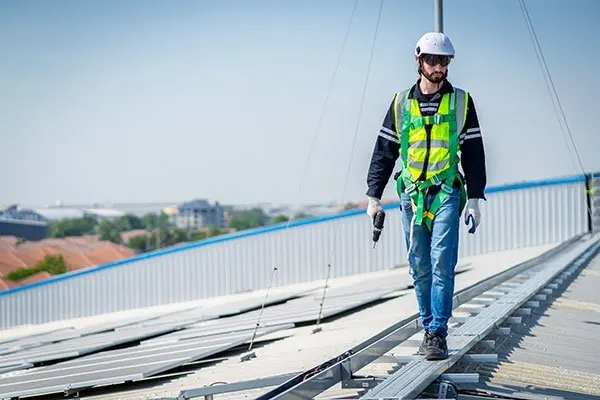
Working at height is dangerous. WorkSafe WA sets rules for fall protection, which can mean edge protection, scaffolding or harness systems depending on the roof. Ask how your roofer plans to manage it. A contractor who takes safety seriously is generally careful in other ways too.
6. The right approach to asbestos
If your home or shed was built between the 1950s and 1980s, the roof may be asbestos cement. WorkSafe WA requires a licensed asbestos removalist to remove more than 10 m² of non-friable asbestos. The WA Department of Health advises against water-blasting or abrasive cleaning of these roofs. A roofer who offers to pressure-clean an old fibro roof is a roofer to avoid. See our asbestos roof replacement page for how these jobs work.
7. Local knowledge
Perth has its own conditions: long hot summers, winter fronts with strong winds, salt air near the coast and bushfire-prone areas in the Hills. A roofer who works locally should be able to talk about the right steel grade for a home near the beach, or what a Bushfire Attack Level means for a house in Kalamunda.
Warning signs
Some patterns come up again and again with poor roofing work. Be wary if someone:
- Knocks on your door after a storm offering a cheap fix "while they're in the area"
- Pushes you to sign on the day or offers a discount that expires tonight
- Asks for full payment or a large cash deposit before materials arrive
- Will not give a written quote or contract
- Cannot or will not provide registration or insurance details
- Offers to pressure-clean or paint an asbestos roof
- Gives a price far below everyone else without explaining what is different
Matching the roofer to the job
Roofing covers several trades, and not every contractor does everything. Some focus on tile work such as re-bedding, re-pointing and restoration. Others mainly install steel roofs, gutters and flashings. Larger re-roofs that involve structural changes may need a registered builder overseeing the job, and an asbestos roof needs a licensed removalist for the strip-off.
When you call, describe the job and ask directly whether it is the kind of work they do every week. A roofer who mostly installs new steel roofs on modern skillion homes may not be the best fit for a delicate terracotta repair on an older house in Fremantle, and the reverse is also true. It is perfectly reasonable to ask for examples of similar jobs they have completed nearby.
Comparing quotes fairly
Lay the quotes side by side and check they are quoting the same job. A table like this helps:
| Item | Quote A | Quote B | Quote C |
|---|---|---|---|
| Material and profile | |||
| New battens or sarking | |||
| Gutters, downpipes, flashings | |||
| Ventilation | |||
| Permit handled by | |||
| Rubbish removal | |||
| Payment stages | |||
| Expected start and duration |
If one quote is missing items the others include, ask that roofer to price them so you are comparing like with like. Price matters, but it is only one column. Our roof replacement cost guide explains what usually pushes a job up or down.
Questions worth asking
During the visit, it is reasonable to ask:
- What exactly is causing the problem?
- Is a repair enough, or does it really need replacing?
- What will you do if you find hidden damage once the old roof is off?
- How will variations be priced and approved?
- Who will actually be on site, and who do I call with questions?
- How long will the house be exposed, and what happens if rain comes in?
- How will you protect gardens, solar panels and paving?
Write down the answers. A roofer who is vague now is unlikely to become clearer once the job is under way.
After the job
When work finishes, walk around the property with the roofer if you can. Check that gutters and downpipes are clear, that offcuts and screws have been collected, and that any flashings look neat. Ask for the final invoice, any product information for the materials used, and notes on maintenance. Keep these with your house records.
How we can help
We arrange quotes from independent local roofing contractors across the Perth metro area, so you can compare options without chasing people yourself. Have a look at our roofing services, or request a free on-site quote and a contractor near you will be in touch to arrange an inspection.