Why bother with an inspection?
Most roof problems start small and out of sight. A bit of cracked pointing, a lifted flashing behind a chimney, a rusted fixing on a steel sheet. None of these shows up on the ceiling until water has been getting in for a while. An inspection is the cheapest way to catch them while they are still small fixes.
There are also specific times when an inspection is worth booking:
- before winter, ideally in March or April, ahead of the May to September wet season
- after a storm, especially one with hail or strong winds
- before buying a home, or when a building report flags the roof
- before installing solar panels, a skylight or an evaporative cooler
- when you notice stains, damp smells or higher-than-usual heat in the house
- when you are weighing up repair against roof replacement
Before the roofer arrives
A little preparation makes the visit more useful.
- Make a list. Note any leaks, stains or noises and when they happen, for example only in strong north-westerly winds.
- Clear access. Move cars from the driveway if a ladder needs to go there, and clear a path to the manhole.
- Find old paperwork. Past repair invoices or the original building plans help the roofer understand what has been done before.
- Secure pets. A roofer moving ladders around the yard does not need a curious dog underfoot.
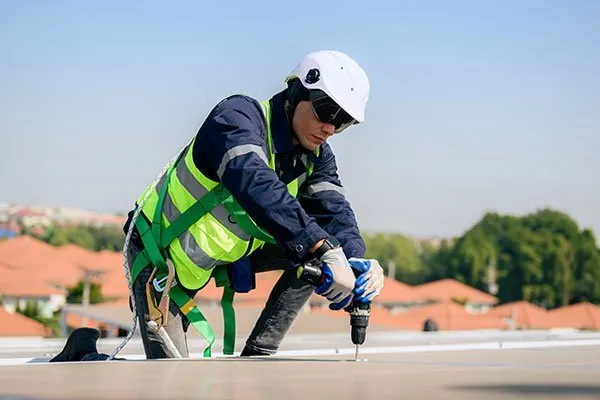
Roofers working at height need edge protection or fall-arrest gear. WorkSafe WA sets the rules, and on steeper or two-storey roofs that may mean extra equipment and time.
Stage 1: The outside of the roof
This is the part most people picture. The roofer gets up on the roof, or uses a ladder and camera where walking on it is risky, and works methodically across each plane.
The roof covering
On tile roofs they look for cracked, chipped, slipped or porous tiles, and test whether the tiles are brittle. On steel roofs they check for rust, dents, loose or missing screws, perished washers and any sign of incompatible metals, such as lead or copper flashings over Zincalume.
Ridge and hip capping
On tile roofs the ridges and hips are checked for cracked bedding and missing pointing. This is one of the most common faults on older Perth concrete tile roofs.
Flashings
Every place the roof meets something else gets a close look: walls, chimneys, skylights, vents, whirlybirds, solar brackets, antennas and cooler units. Sealants that have dried out in the summer sun and flashings that have lifted in wind are frequent findings.
Valleys, gutters and downpipes
Valley irons are checked for rust, debris and correct lapping. Gutters are checked for blockages, sagging, rust and fall. Downpipes are checked to make sure water is actually leaving the roof. Box gutters on modern homes get extra attention because a blocked outlet can send water straight into the house.
Stage 2: The roof space
A thorough inspection includes the roof space wherever there is safe access. From inside, the roofer is looking at the hidden layers that decide whether a roof can be repaired or needs replacing.
| What they check | What they are looking for |
|---|---|
| Battens and rafters | Water stains, rot, splits, rusted nails or brackets |
| Sarking | Tears, sagging, missing sections, pooled water |
| Insulation | Wet, stained or compressed batts |
| Daylight | Gaps that will let wind-driven rain in |
| Ventilation | Heat build-up, condensation marks, blocked vents |
| Structure | Signs of movement or sagging in the frame |
If you have a steel roof with no roof blanket, they may point out condensation marks. Our guide on roof ventilation in Perth explains why airflow matters in our summers.
Stage 3: Inside the home
Finally, the roofer looks at ceilings and walls under the roof. Stains, bubbling paint near cornices and sagging plasterboard help match what they saw outside with where water is ending up. If you have a leak that only shows in certain weather, this is when your notes are most useful. Our roof leaks and water damage guide explains how water travels before it appears.
Special cases
Asbestos roofs
Homes and sheds built in Perth from the 1950s to the 1980s may have asbestos cement roofing. A roofer should inspect it without walking on or breaking it. If replacement is needed, it involves a licensed asbestos removalist. See asbestos roof replacement.
Coastal and hills homes
Near the coast, the roofer should pay close attention to corrosion on sheets, fixings and flashings. In bushfire-prone parts of the Perth Hills, they may comment on gaps where embers could enter, and any replacement may need to meet a Bushfire Attack Level under AS 3959. Check with your local government.
When the roofer can't get on the roof
Some roofs are too steep, too fragile or too high to walk safely. Brittle terracotta, wet steel and asbestos cement are all examples. In those cases a roofer may inspect from a ladder at several points around the house, use a camera on an extension pole, or use a drone where that is practical and permitted. These methods give good coverage of the surface, though they cannot test whether tiles are brittle or screws are loose. Ask how your roof will be inspected and what that means for the findings.
What an inspection can't tell you
Even a thorough inspection has limits. A roofer can see stains and damp, but cannot always tell exactly when a leak started. Areas with no roof-space access, such as raked ceilings and some flat roof sections, can only be judged from outside. Structural concerns, like a sagging frame, may need a structural engineer to assess properly. A good report will say clearly what could not be inspected and why, rather than leaving gaps unmentioned.
What you should get afterwards
An inspection is only as good as the report that follows. Expect:
- photos of each issue, labelled by location
- a plain-English description of the condition of the covering, ridges, flashings, valleys, gutters and roof space
- a priority order, separating urgent work from things that can wait
- recommended repairs, and a replacement option if the roof is near the end
- a note of anything that needs a specialist, such as suspected asbestos or structural concerns
If the report recommends replacement and you are not sure, compare it with our checklist of signs you need a roof replacement. We don't publish prices because every roof differs; the roof replacement cost guide explains what drives the numbers.
We ask the contractors we work with to hold the registrations and insurance the job needs. Ask to see them before work starts.
Questions worth asking on the day
- Which of these problems will get worse over the next winter if left?
- Is there a repair option, and how long would it realistically last?
- Did you see any sign of water in the roof space, and where was it coming from?
- Is anything on the roof unsafe for me or other trades to walk on?
Book an inspection
If your roof has not been looked at in a while, or something has changed, an on-site inspection is the place to start. Request a free quote through our contact page and a local roofer will inspect the roof and talk you through what they find.